European Location
Dunmore Europe develops and manufactures aerospace material systems, offering short lines of communication with European customers and direct technical collaboration.
Weight, temperature resistance, radiation resistance: We make no compromises in these areas.
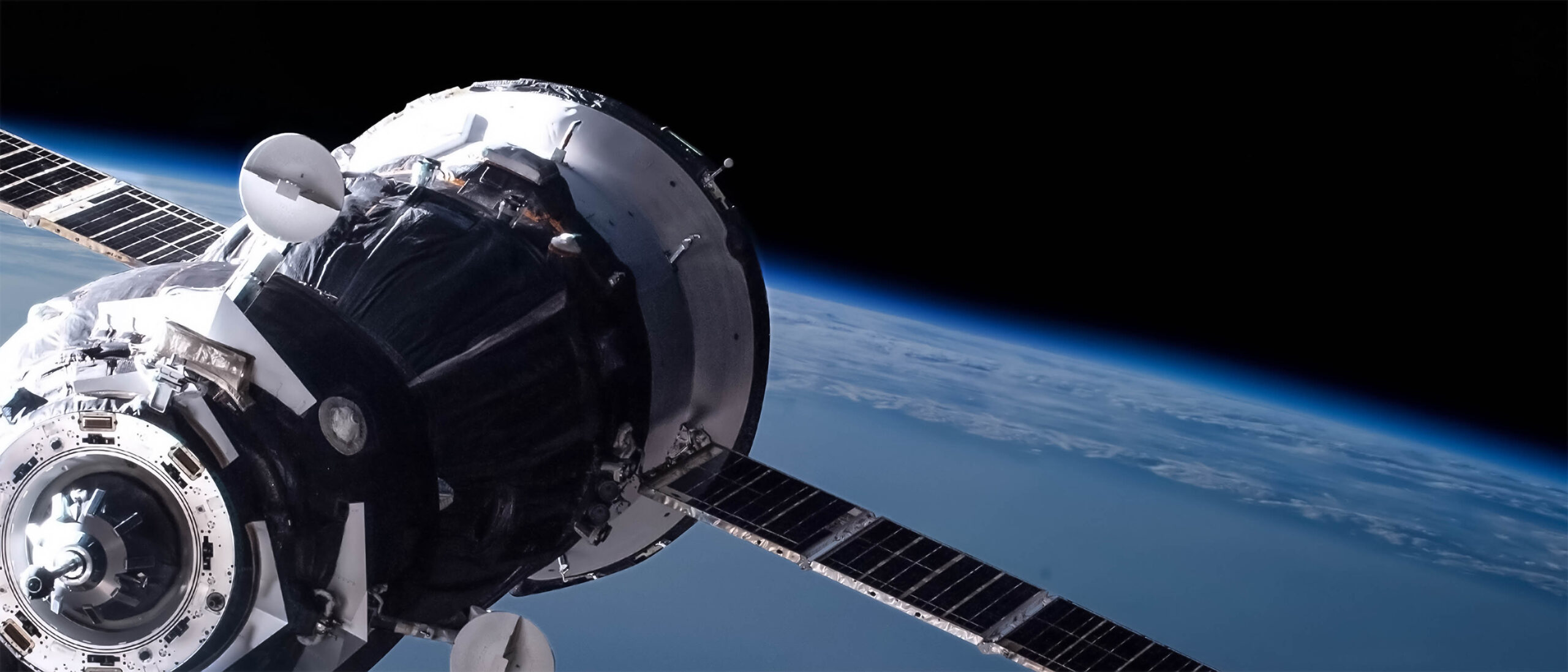
From the initial request to a proven production solution: Dunmore supports European aerospace projects as a development partner with over 50 years of aerospace experience.
Reducing weight without compromising protective performance. Minimizing outgassing without sacrificing barrier performance. Ensuring temperature resistance without compromising the layer structure. These conflicting objectives shape every material decision in the aerospace industry—and this is precisely where Dunmore’s work comes in.
Dunmore Europe is strategically expanding its European aerospace division: with development and manufacturing in Freiburg, short development cycles for European customers, and the technical expertise gained from over 50 years of aerospace experience by our U.S. colleagues. Those who partner with Dunmore Europe don’t start from scratch—they start with a proven portfolio of materials and a team that understands the industry’s qualification requirements.
Dunmore Europe develops and manufactures aerospace material systems, offering short lines of communication with European customers and direct technical collaboration.
Quality Management System in accordance with ISO 9001:2015—for reproducible results, traceability, and delivery reliability in safety-critical applications.
Dunmore supports projects with engineering expertise tailored to the long qualification cycles in the aerospace industry.
Dunmore Aerospace has already supported NASA and ESA programs with technical film systems.
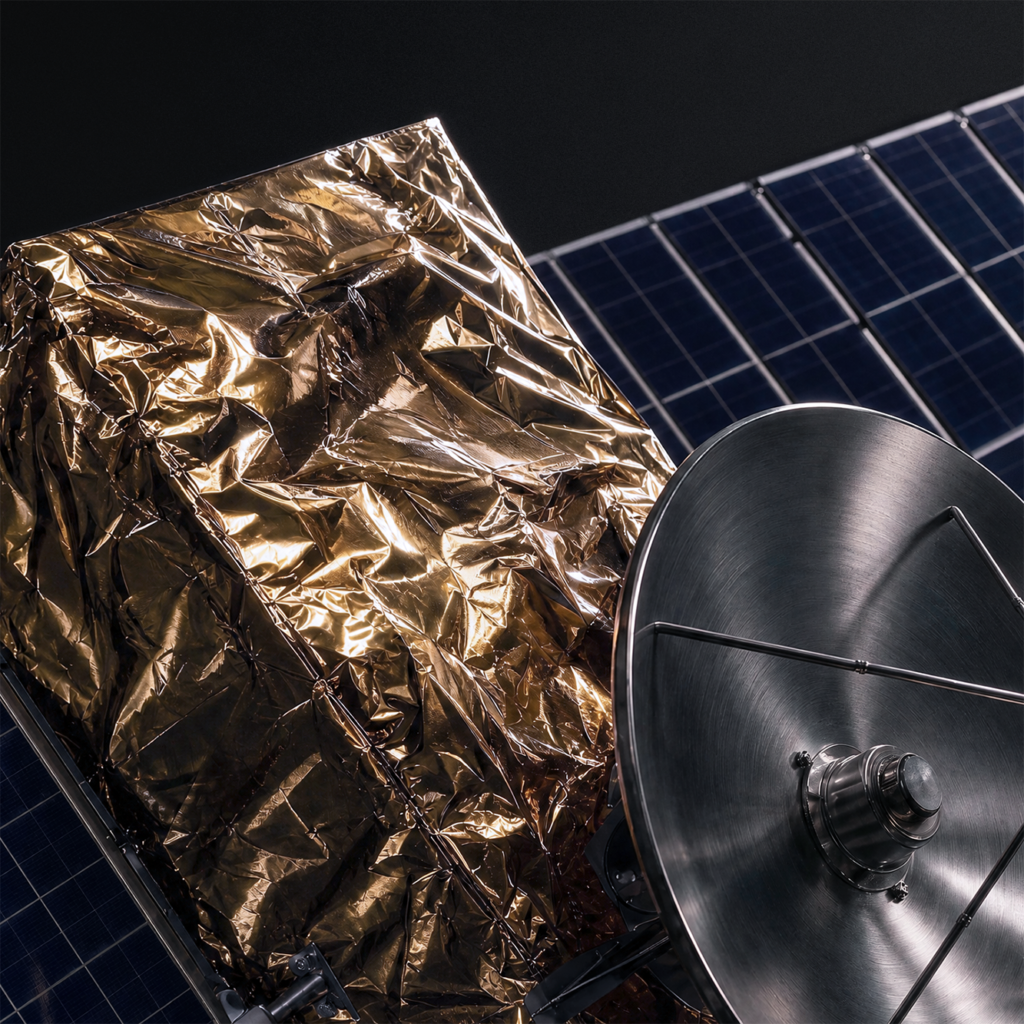
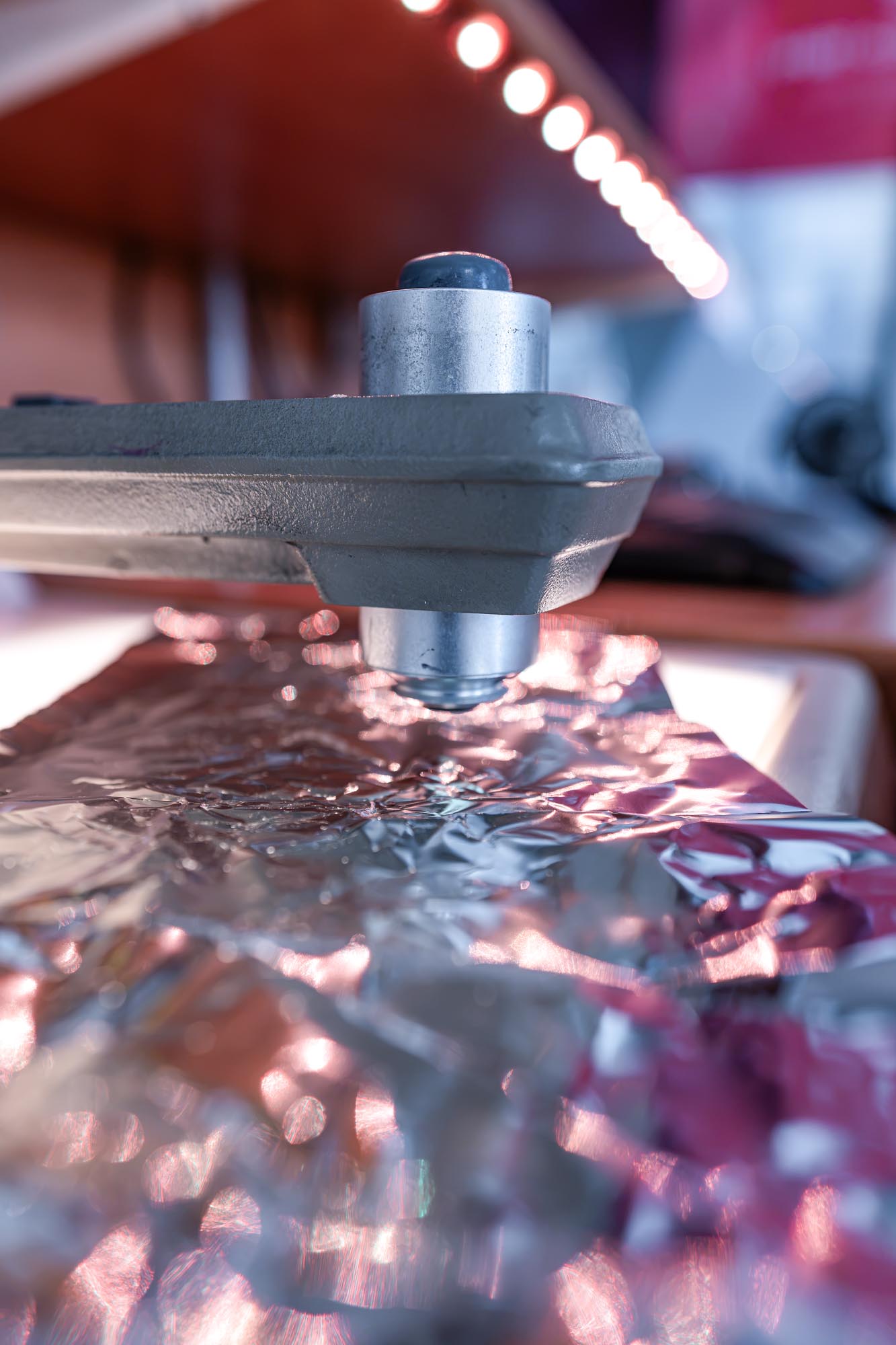
In space, temperatures range from minus 170 to plus 120 degrees Celsius—depending on whether a satellite is facing the Sun or not. MLI systems address this challenge with multiple metallized layers that reflect thermal radiation without adding significantly to the total weight. Our metallized PET films for multi-layer insulation are designed for a defined emissivity, controlled outgassing behavior, and reproducible coating quality.
Cabin linings and insulation films in aircraft are not a design choice, but a safety consideration. Weight, fire behavior, and long-term stability are the key parameters. Our coated and laminated aircraft films meet these requirements: they are lightweight, dimensionally stable, heat-reflective, and moisture-resistant.
An adhesive tape that fails under vacuum or loses its adhesive strength under thermal stress is simply not an option in aerospace applications. The performance of an aerospace tape stands or falls on the quality of its backing film. For this application, backing films are needed that combine extreme temperature resistance, mechanical strength, and defined outgassing behavior in a single material—and that is precisely our approach.
In spaceflight, heat that cannot be dissipated poses a systemic risk. DUN-COOL™ is our product line for thermal management applications: materials that specifically combine heat reflection and thermal stability.
Electrostatic discharges pose a real risk to satellites and spacecraft: Even small differences in charge can damage sensitive electronics or interfere with measurement systems. Electrostatic dissipative (ESD) films dissipate charges in a controlled manner before they build up. They are used where electronics, film, and a vacuum environment come into contact.
Do you have a specific requirement for the aerospace sector? Or would you like to find out if Dunmore is the right development partner for your project? Our team in Freiburg will answer your questions directly—no beating around the bush.
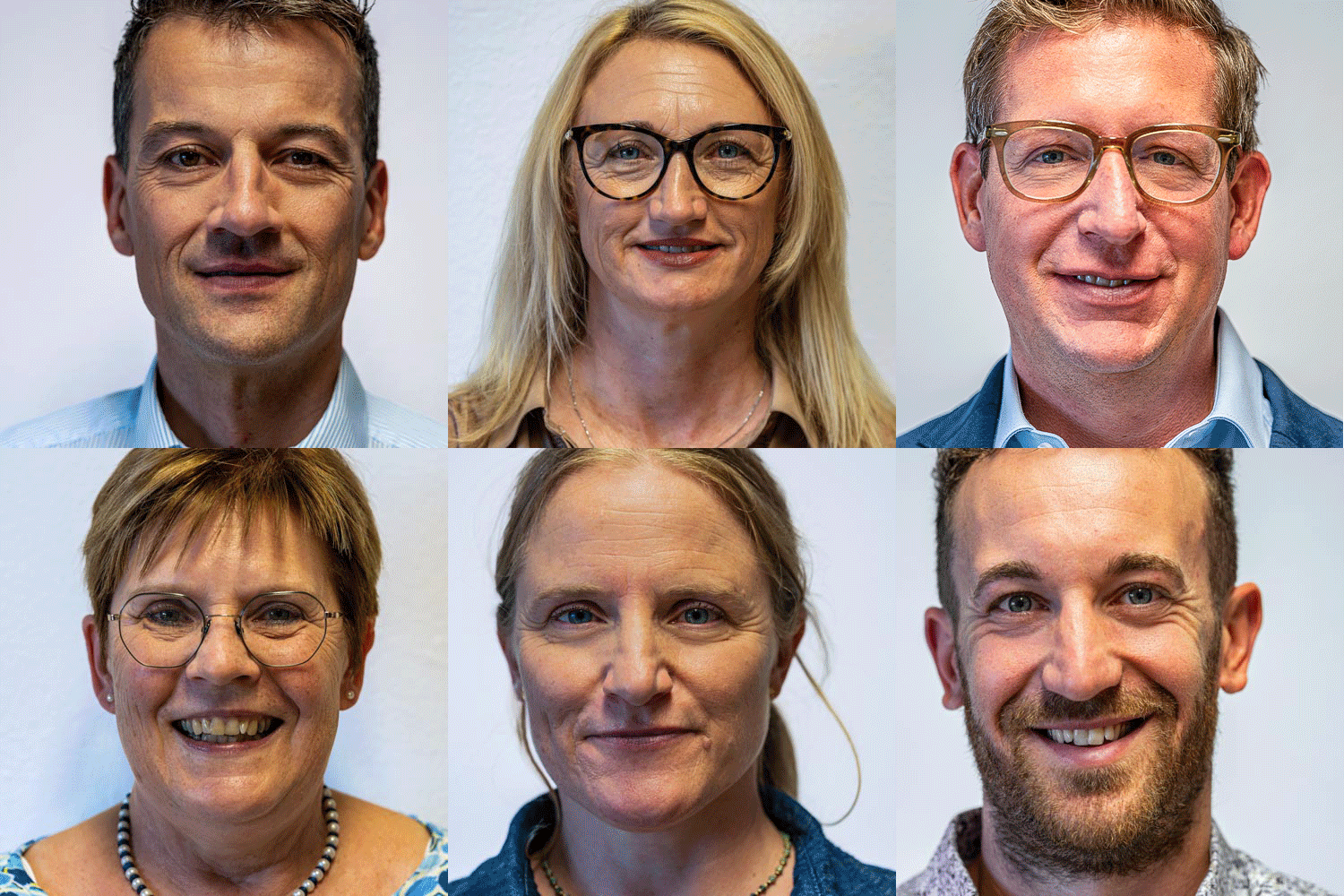
Team Dunmore Europe
kontakt@dunmore.de
Aerospace films are metallized, coated, or laminated high-performance films used in aircraft and spacecraft for thermal insulation, surface protection, electrostatic dissipation, and structural protection. Typical applications include multi-layer insulation (MLI) for satellites, aircraft films for cabin linings and insulation, backing films for aerospace tapes, and materials for the thermal management of spacecraft. Requirements include low weight, defined outgassing behavior, temperature resistance, and long-term dimensional stability.
Dunmore relies on an integrated process chain consisting of metallization, coating, and lamination. Metallized films are produced using thermal vacuum deposition (PVD), in which aluminum or other metals are applied to the carrier substrate as a thin, uniform layer. Functional coatings complement the structure by providing protective, adhesive, or barrier properties. Lamination bonds multiple layers into a composite that meets several requirements simultaneously. All processes are carried out using roll-to-roll manufacturing and are tailored to the requirements of the aerospace industry.
Dunmore has been developing and manufacturing technical films for aerospace applications for more than 50 years. Its production facilities in Freiburg (Europe) and the United States are certified to ISO 9001:2015. Dunmore supports projects from the initial requirements specification through to production-ready delivery—including prototype manufacturing, validation, and qualification support. The integrated process chain—comprising coating, metallization, and lamination—reduces interface risks and enables reproducible results, even for complex specialty laminates.
Dunmore Europe is certified to ISO 9001:2015. For specific aerospace standards and product qualifications, please contact our team directly—we’ll work with you to determine which specifications are relevant to your application.
The first step is a technical consultation: we discuss the requirements profile, application, specifications, and quantities together. Dunmore assesses feasibility, recommends suitable materials and processes, and, upon request, produces lab samples for initial testing. Once validation is complete, we move on to optimization and the production process. For inquiries, please contact our team in Freiburg directly—you’ll find their contact information at the bottom of this page.